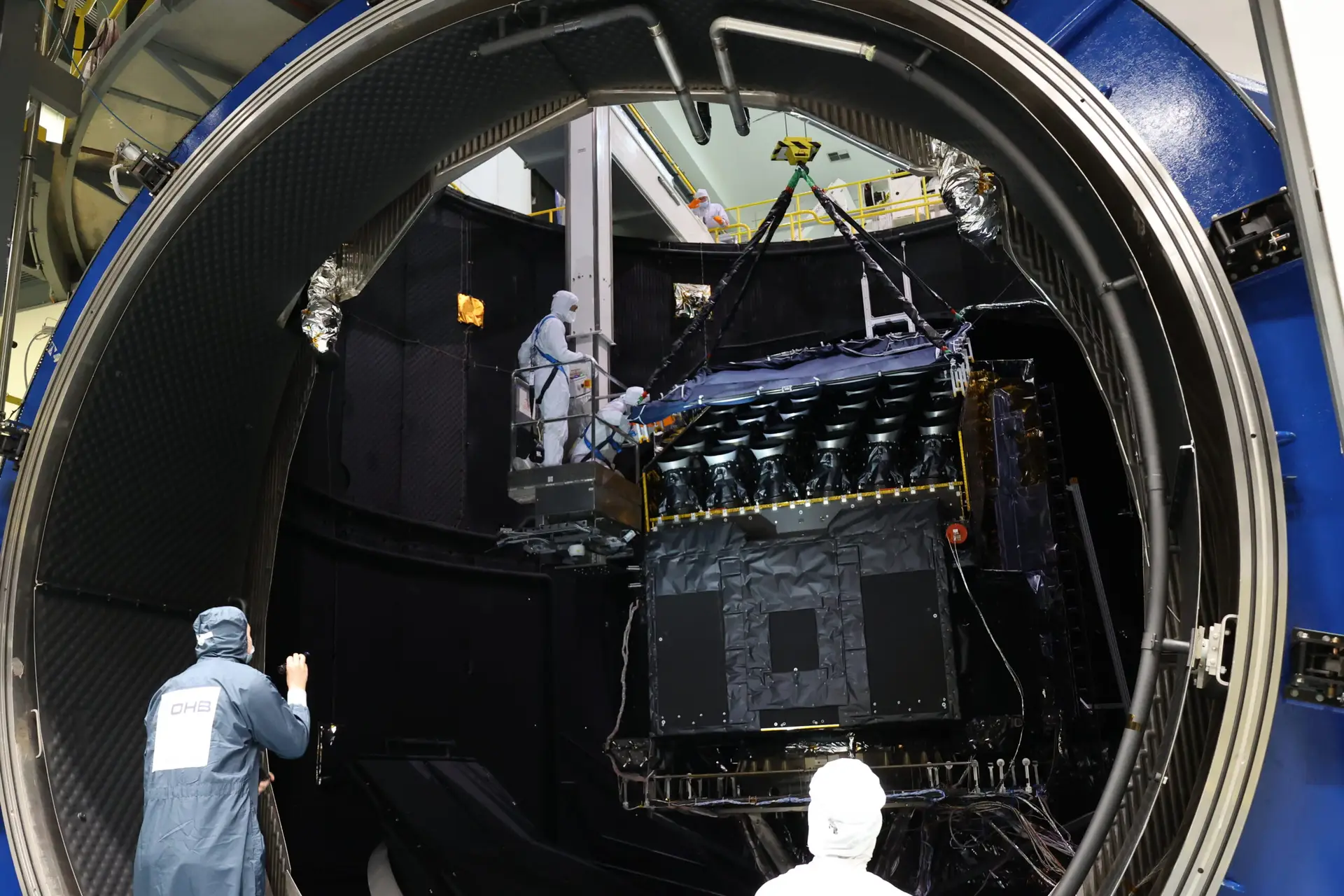
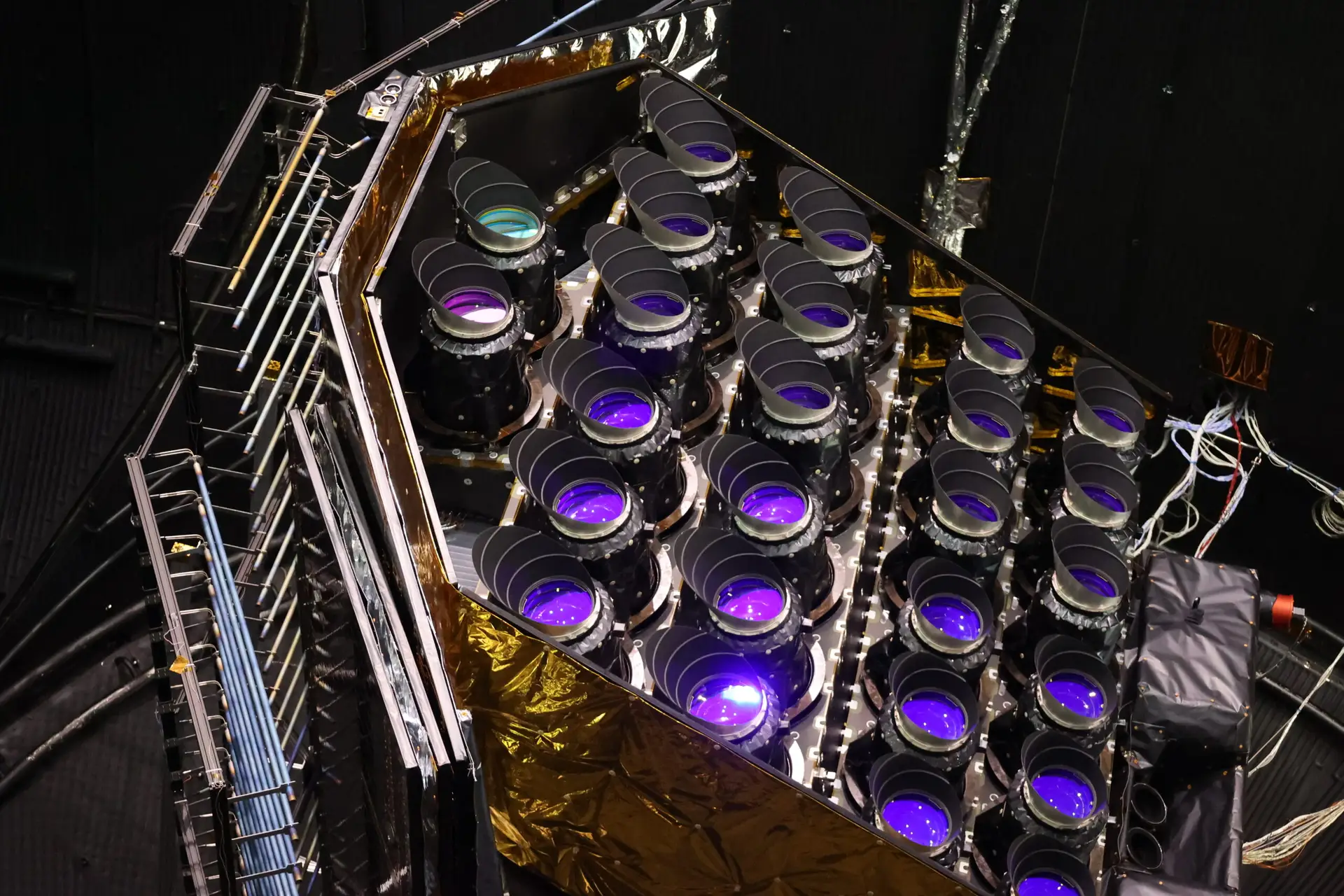
For weeks, the European Space Agency’s PLATO space telescope endured conditions that mirror the harsh reality of space: searing heat, extreme cold, and near absolute vacuum. Inside ESA’s Large Space Simulation chamber at ESTEC, the spacecraft was pushed to its limits. Working in close partnership with ESA, OHB led this demanding thermal vacuum test campaign—and with the opening of the test chamber doors on 6 April 2026, a major milestone for ESA’s scientific mission PLATO (PLAnetary Transits and Oscillations of stars) was successfully achieved.
In so-called thermal vacuum tests, a spacecraft is exposed to the conditions it will later encounter in space: extreme temperatures, strong temperature fluctuations, and a near-total vacuum. The aim of these tests is to demonstrate that all systems and instruments function reliably under these realistic space conditions. For space missions, these tests are among the most demanding phases of qualification.
Close Collaboration with ESA
Throughout the thermal vacuum campaign, OHB’s AIT, engineering, thermal, and system teams worked closely with ESA to comprehensively test all spacecraft subsystems and the scientific payload. The successful completion confirms the technical robustness and operational readiness of the PLATO spacecraft.
ESA’s PLATO Project Manager, Thomas Walloscheck, said: “This was a very important step towards launch and only possible due to the dedication of all the teams of ESA, the industrial Plato Core Team and ETS working closely together. With this test campaign we showed that the spacecraft and payload is working in the demanding environments of space and we can control the thermal focussing of the cameras to precision as needed.”
The PLATO AIT-Manager at OHB, Jack Hazeldine, emphasized: “The highly complex test setup in ESA’s space simulator and the stringent cleanroom requirements posed significant challenges. Thanks to the excellent cooperation among all teams involved, we were able to fully achieve all test objectives.”
From a system perspective, the milestone is equally significant. “Thermal vacuum tests are a key demonstration that a satellite can withstand the stresses of space,” explained Laura León, PLATO System Engineer Manager. “The positive outcome highlights not only technical excellence, but also the exceptional commitment and flexibility of the entire team.”
Pablo Jorba Coloma, PLATO Project Manager at OHB, added: “This test campaign is an impressive demonstration of OHB’s capabilities and the outstanding collaboration among all partners. It brings the PLATO mission a major step closer to its operational phase in space.”
This milestone represents the completion of the so called “environmental campaign”, during which the robustness of the PLATO spacecraft to sustain the severe launch conditions and to operate in the harsh space environment has been demonstrated. In the coming months, the PLATO team will carry out further testing, such as electro-magnetic compatibility tests, to achieve the final Qualification Review and confirm the spacecraft readiness for the launch, currently scheduled for January 2027.
The PLATO Mission: In Search of a Second Earth
PLATO is a space mission of the European Space Agency (ESA) dedicated to the search for planets beyond our solar system: the so called exoplanets orbit distant stars. Using its highly sensitive cameras, PLATO will observe many stars simultaneously and detect tiny variations in brightness caused when a planet passes in front of its host star. This allows new planets to be discovered and their properties to be studied. The mission aims to improve our understanding of how planetary systems form—and to determine whether there are planets in our galaxy that resemble Earth and could potentially be hospitable to life.
The PLATO payload, the PLATO ground segment, and the PLATO data processing system are joint developments of ESA and the PLATO Mission Consortium (PMC). Funding for the PMC is provided at the national level, in particular by the countries participating in the PLATO Multilateral Agreement (Austria, Belgium, the Czech Republic, Denmark, France, Germany, Italy, the Netherlands, Portugal, Spain, Sweden, Switzerland, Norway, and the United Kingdom), as well as by institutions from Brazil.