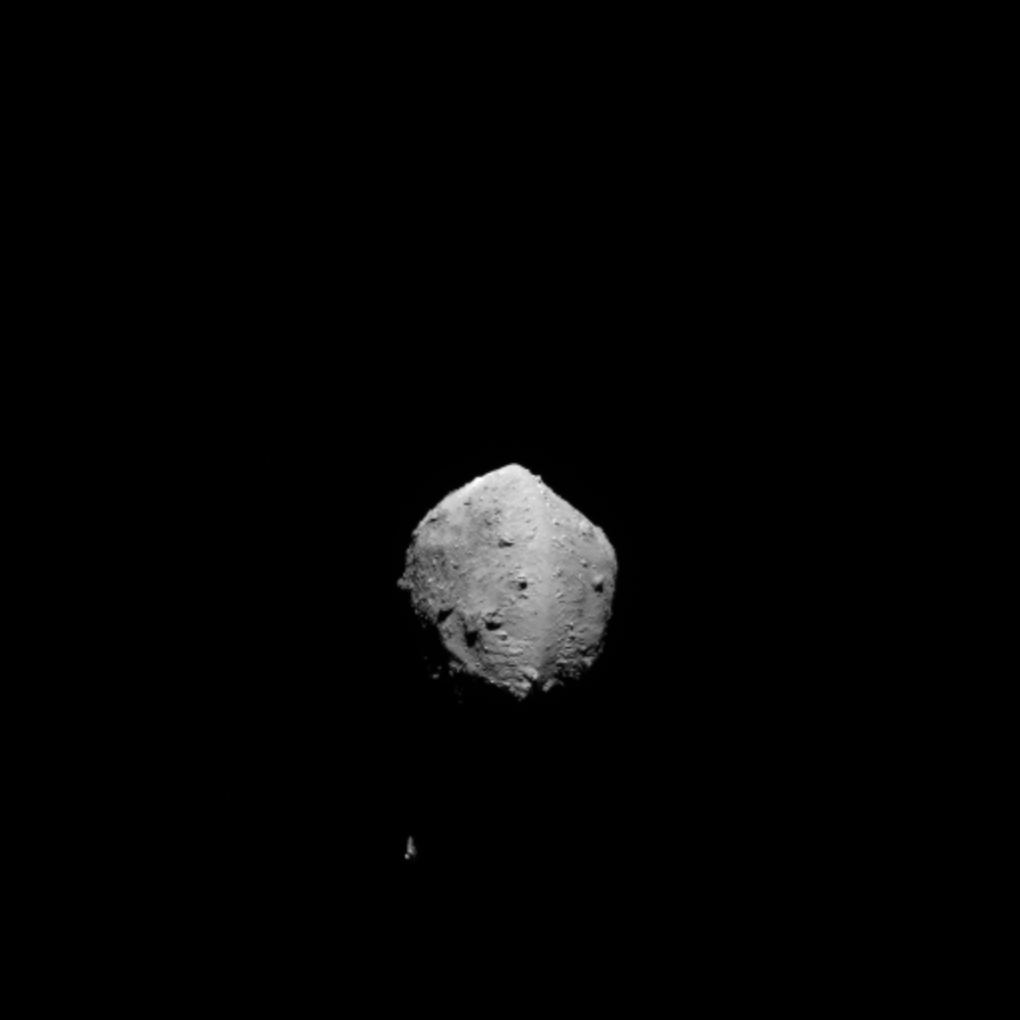
After traveling millions of kilometers through interplanetary space over the past two years, Hera, the spacecraft built by OHB for the European Space Agency (ESA), has returned its first close-up images of the Didymos asteroid system. The newly released views mark the start of the final and most critical phase of Europe’s first planetary defense mission.
Captured from around 60 kilometers away, the image reveals a previously unseen side of Didymos, the larger member of the binary asteroid system. The asteroid’s rugged surface, marked by boulders, craters, and ridge-like features, offers scientists a first glimpse of the environment Hera will soon investigate in unprecedented detail.
“Seeing Hera’s first close-up images from the Didymos system is a special moment for everyone involved in this mission,” said Marco Fuchs, CEO of OHB. “After years of development, testing, and operations, the spacecraft is now delivering exactly what it was designed to do. These first images demonstrate the outstanding performance of Hera and are only the beginning. In the coming weeks, the mission will provide the data needed to understand the outcome of humanity’s first successful asteroid deflection experiment and help strengthen our ability to protect Earth from future threats.”
The first close-up image, published by ESA, represents an important milestone as Hera continues its final approach toward the asteroid pair. The spacecraft will move progressively closer to Didymos and Dimorphos, capturing increasingly detailed observations of both bodies. High-resolution imaging of the DART impact site is expected during the mission’s rendezvous phase.
Hera demonstrates outstanding performance on final approach
All spacecraft systems have been successfully tested and verified. Most recently, Hera completed rehearsals for its complex rendezvous and proximity operations. Following a series of precise trajectory-correction and braking maneuvers, the spacecraft is now on its final approach path.
The mission team has also completed deployment rehearsals for Hera’s two CubeSats, Juventas and Milani. To support these activities, OHB temporarily reconfigured its Avionic Test Bench, a full-scale spacecraft model equipped with functioning electronics and cameras, from ESA’s follow-on mission RAMSES back to the Hera configuration. The deployment rehearsals were completed successfully. Once released, the CubeSats are expected to provide unique insights into the asteroid’s internal structure and composition.
For European spaceflight, Hera’s arrival marks a major milestone. Launched from Cape Canaveral on 7 October 2024, the spacecraft is heading to the Didymos-Dimorphos system to investigate the aftermath of NASA’s DART impact. In 2022, DART demonstrated for the first time that an asteroid’s orbit can be altered through kinetic impact. Hera will now provide the detailed measurements needed to assess the effectiveness of that technique with unprecedented accuracy.
A record-breaking project made in Bremen and powered by European teamwork
Hera is also the result of an exceptional European industrial achievement. Led by OHB, the spacecraft was developed, built, integrated, tested, and launched in just four years, an exceptionally short schedule for a deep-space mission of this complexity. The mission brings together around 100 companies and research institutions from 18 ESA Member States.
The knowledge gained at Didymos and Dimorphos will help shape future international planetary defense strategies and is already supporting preparations for ESA’s follow-on asteroid mission, RAMSES, which is also being built by OHB and its industrial partners.
The successful development of Hera demonstrates Europe’s ability to deliver highly complex planetary-defense missions on ambitious schedules.
Attention is now turning to the asteroid system itself. The first close-up images already offer scientists a new perspective on Didymos and may provide valuable clues about how material was redistributed throughout the system following the DART impact. As Hera continues its approach, the mission will gather the detailed data needed to transform asteroid deflection from a one-time demonstration into a well-understood and potentially repeatable planetary-defense capability.
The next major milestone will follow on November 25, when ESA unveils detailed images of both asteroids, providing an unprecedented look at the target of humanity’s first successful asteroid-deflection test.