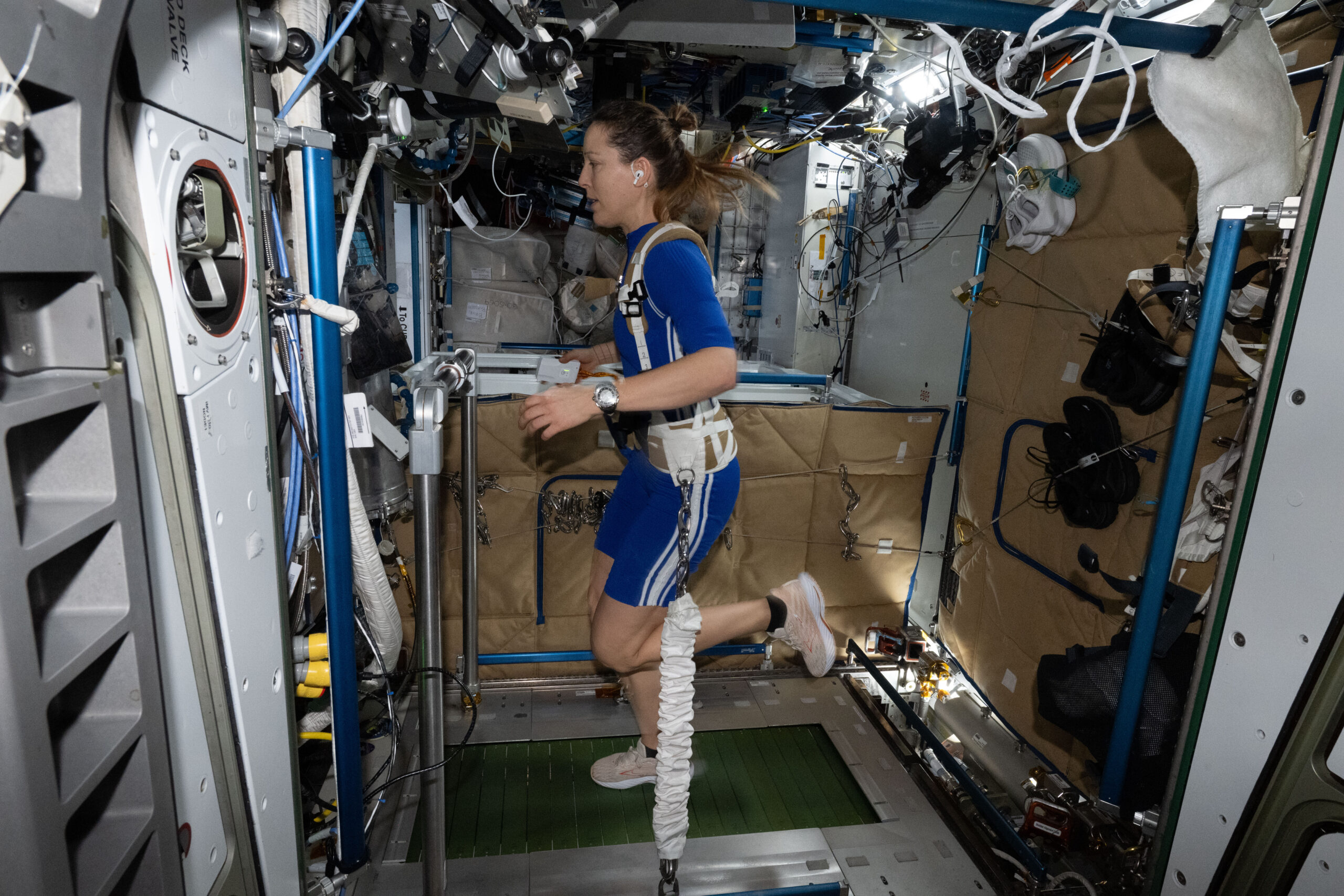
French ESA astronaut Sophie Adenot has begun the “EasyMotion-2” experiment aboard the International Space Station (ISS). The objective of the study is to scientifically evaluate the benefits of electro muscle stimulation (EMS) as a supplementary training method to counter muscle atrophy in microgravity. The training suits used for the experiment were qualified by OHB for deployment in space.
On behalf of the German Space Agency at DLR the experiment is carried out by “Charité – Universitätsmedizin Berlin”. Additional partners include the European Space Agency (ESA) and EMS GmbH, the manufacturer of the EasyMotionSkin system. During the six-week study, Sophie Adenot will train using an EMS suit whose integrated electrodes selectively stimulate specific muscle groups. In addition, changes in muscle tone and muscle condition will be measured using the MyotonPRO system, which was also qualified by OHB for use aboard the ISS, in order to assess the effectiveness of the training regimen under spaceflight conditions.
From Technology Demonstration to Scientific Validation
Before the beginning of her “εpsilon” mission, Adenot became familiar with the system during a fitting and training session at DLR’s Aerospace Medicine Research Facility in Cologne. There, she received instruction from the scientists involved in the project as well as Dr. Marco Berg, Project Manager in OHB’s Human Spaceflight division.
“Having the opportunity to personally train Sophie Adenot on the system before her mission and now support her during the experiment is a source of great pride for us. Qualifying systems like these for use in space require extensive aerospace expertise, uncompromising reliability, and a deep understanding of the needs of scientific research. These are precisely the capabilities that OHB has successfully contributed to international human spaceflight projects for many years,” says Marco Berg.
German ESA astronaut Matthias Maurer had already successfully tested the EasyMotion system aboard the ISS during his “Cosmic Kiss” mission. Following that technology demonstration, the focus has now shifted to the scientific validation of the system’s additional training benefits. On behalf of the German Space Agency at DLR, OHB has procured the training equipment for a total of eight future astronaut missions and qualified it for use on the ISS. This will make the technology available to additional space station crew members in the years ahead.
Contributing to the Future of Human Spaceflight
The results of the experiment could help to make future astronaut training programs more efficient. New approaches are particularly important for long-duration missions, such as future journeys to Moon and Mars, where effective countermeasures against muscle and bone loss are essential while at the same time conserving valuable onboard time and resources.
With the qualification of the EasyMotion-2 system, OHB continues its longstanding support of research activities aboard the ISS. As an industrial partner for human spaceflight programs and a key contributor to Columbus, Europe’s laboratory module on the ISS, the company regularly brings its expertise to the preparation and execution of scientific missions in space. Through these efforts, OHB plays an important role in making innovative technologies available for safe and reliable use in space and in enabling research under the unique conditions of microgravity.