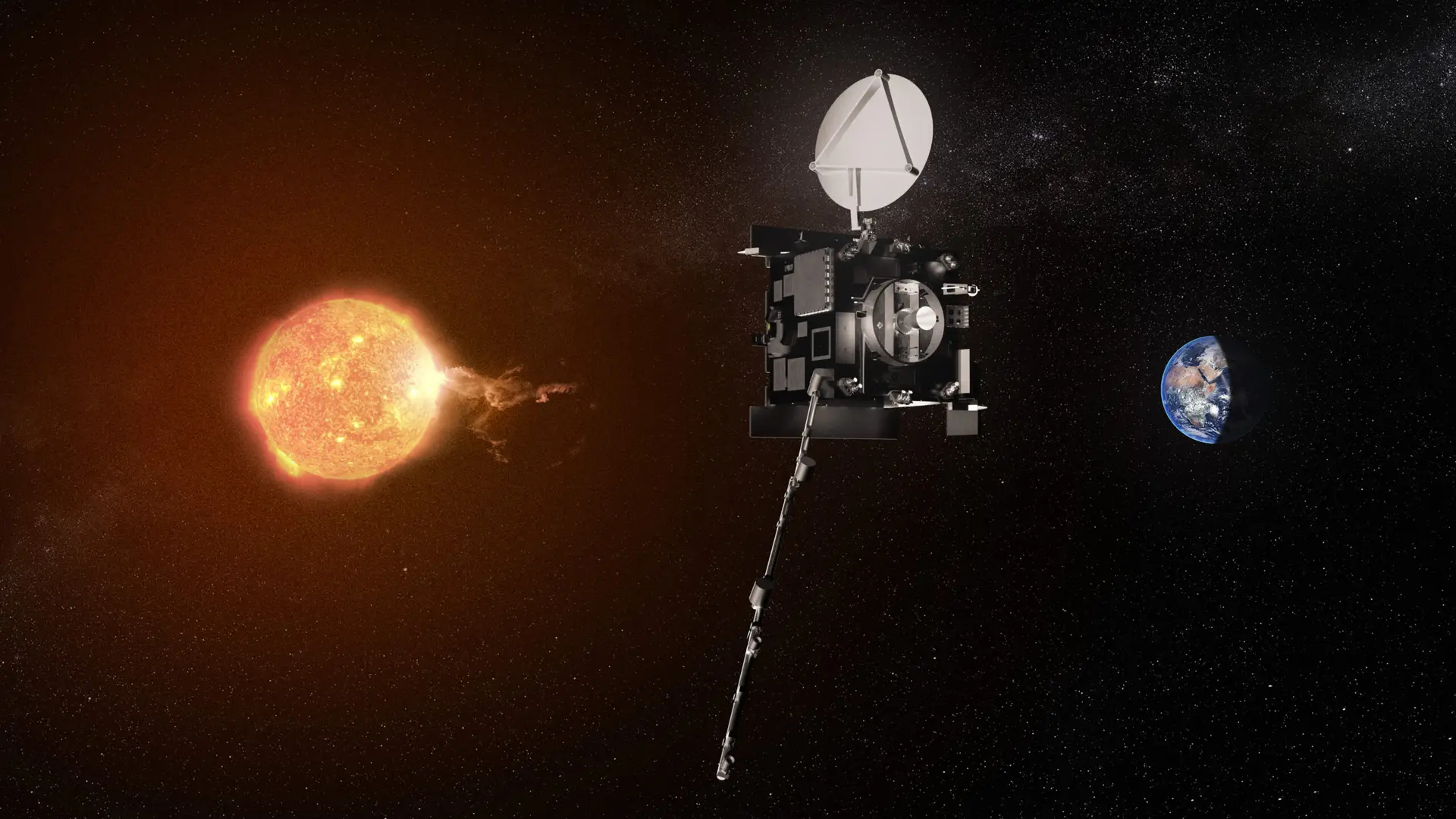
Antwerp Space has officially started development of the communication subsystem for Vigil, a flagship space safety mission of the European Space Agency (ESA) designed to strengthen Europe’s ability to monitor and respond to space weather.
“We are proud to contribute to Vigil, a mission that will play a crucial role in protecting critical infrastructure on Earth,” said Koen Puimege, Managing Director of Antwerp Space. “Reliable deep-space communication is essential for the success of this mission, and our team is committed to delivering high-performance technology that enables continuous, secure connectivity across vast distances.”
Improving Early Warning Capabilities
Solar activity, including flares and coronal mass ejections, can have significant impacts on Earth, disrupting satellite operations, communication and navigation systems, power grids, and aviation. As modern society becomes increasingly dependent on space-based infrastructure, improving early warning capabilities is critical to ensuring security and operational continuity.
Vigil will operate from the Sun–Earth Lagrange point L5, a stable position approximately 150 million kilometers from Earth. From this vantage point, the spacecraft will observe the Sun from the side and enable the monitoring of active solar regions before they are visible from Earth. This early warning capability will allow operators to take preventative measures, reducing the impact of space weather on critical infrastructure. As Europe’s first continuous, 24/7 operational space-weather monitoring mission, Vigil will provide earlier and more accurate forecasts of hazardous solar activity.
High-Power Amplifiers for Signal Transmission
The spacecraft will be built by Airbus Defence and Space, the mission’s prime contractor. Antwerp Space is responsible for the communication module, which ensures uninterrupted connectivity between the spacecraft and Earth throughout the mission lifetime. The communication subsystem includes deep-space transponders to manage radio-frequency links and high-power amplifiers to transmit signals across vast distances. A network of waveguides and switches routes and controls these signals within the spacecraft. Together, these technologies enable reliable communication across deep space, bridging the approximately 150 million kilometers between Earth and the spacecraft.
The development is being carried out in collaboration with key European partners, including Thales Alenia Space and Exens Solutions, highlighting Antwerp Space’s integral role in the European space industry.
This project builds on Antwerp Space’s strong heritage in space communications, contributing to missions such as Juice, Ariel and the ISS modem Argo, as well as ongoing developments for future ESA science missions. The Vigil mission’s launch is targeted for 2031.