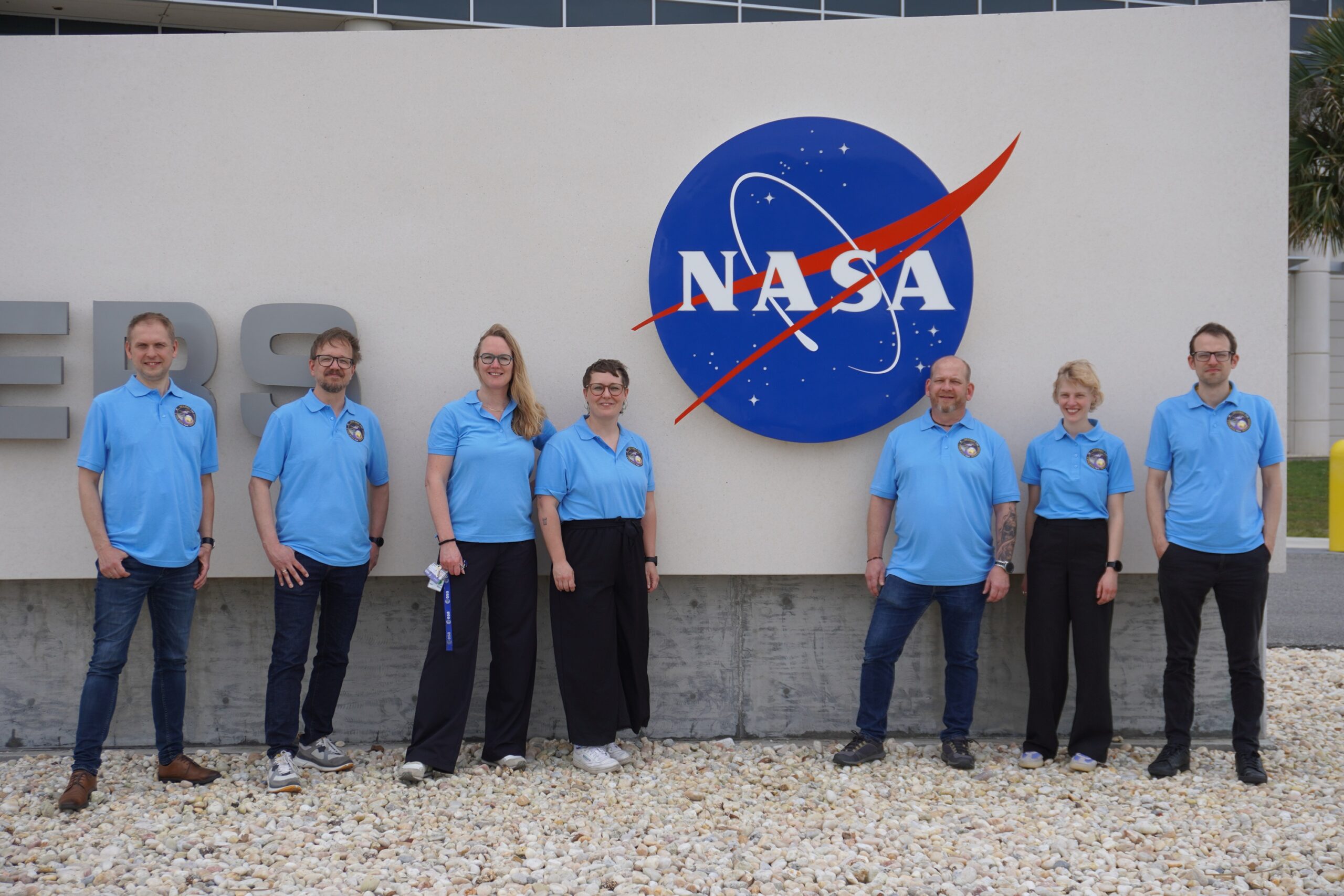
With the arrival of LUX in Space aboard the International Space Station (ISS), a pioneering research project dedicated to studying DNA repair mechanisms under microgravity conditions has successfully reached orbit. Acting as the industrial prime contractor, OHB is responsible on behalf of the European Space Agency (ESA) for the development, manufacturing, integration, and operation of the complete LUX in Space hardware. The space technology company also supports all in orbit operations on the ISS from ground control throughout the entire experimental campaign.
Scientific leadership for the mission lies with the Institute of Aerospace Medicine at the German Aerospace Center (DLR), where the biological experiment was conceived and developed.
What Is LUX in Space – and Why Does the Experiment Matter?
“Put simply, LUX in Space aims to investigate how DNA damage caused by space radiation is repaired in cells under microgravity conditions compared to Earth’s gravity,” explains Johanna Piepjohn from the DLR Institute of Aerospace Medicine. “This is a crucial issue for future human missions to the Moon or Mars.”
Jürgen Kempf, who has been developing and coordinating the technical implementation of complex scientific space experiments at OHB for more than 19 years, adds: “For LUX in Space, we developed specialized hardware in which all experimental steps are fully automated. The main challenge was translating demanding scientific requirements into highly complex measurement systems that operate reliably under microgravity conditions.”
Preparing LUX in Space for Launch
Measurement data are collected automatically and transmitted directly to scientific teams on the ground.
“This is the first time the entire DNA damage repair chain is being studied directly under real microgravity conditions,” says Benjamin Tiller Thaden, Lead System Engineer for LUX in Space at OHB. “Our measurement technology allows us to observe repair processes in situ and in real time.”
Who Initiates the Experiment on the ISS – and How Did the Bacteria Survive the Journey?
Activation of the experiment was carried out by the ISS crew led by Commander Jessica Meir (Crew 12) together with ESA astronaut Sophie Adenot. Operations take place in the Biolab facility located within the European Columbus module. A total of three experimental runs are planned.
While the bacterial cells tolerated the launch delays without any loss of viability at a storage temperature of four degrees Celsius, their activation at 30 degrees Celsius aboard the ISS now marks the start of a mission that sets new benchmarks for the industrial implementation of biological research in space – and delivers valuable insights for the future of human spaceflight.
Teamwork and Strong Partnerships Between Industry and Science
The experiment is commissioned by the European Space Agency (ESA), with scientific leadership provided by the DLR Institute of Aerospace Medicine. With LUX in Space, OHB demonstrates its ability to translate complex scientific requirements into robust, flight qualified space systems – from early concept development and qualification through to successful in orbit operations.