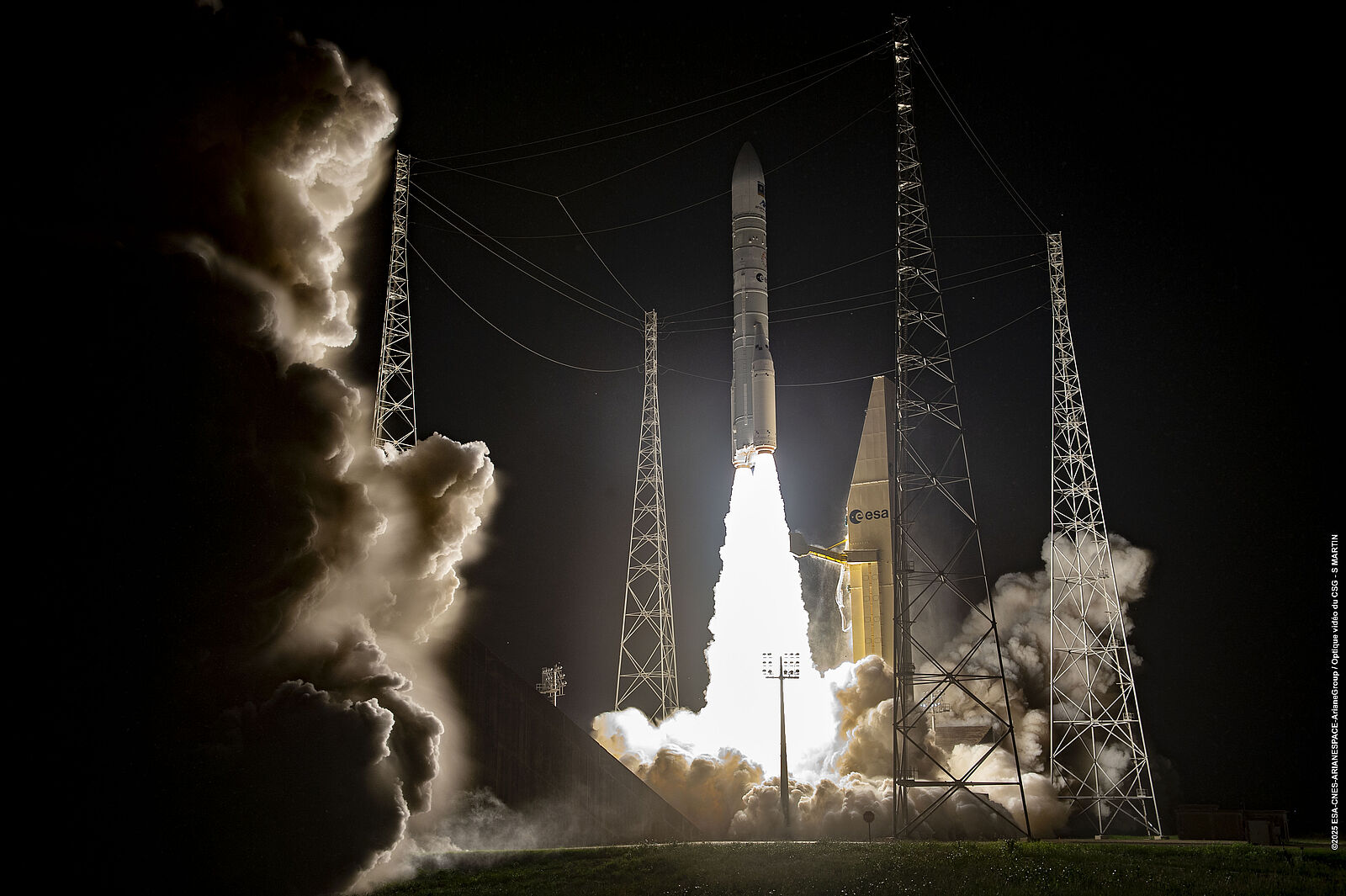
Two new satellites for the European Galileo navigation system were successfully launched into space today at 6:01 a.m. (2:01 a.m. local time) from the Kourou spaceport in French Guiana. With this launch, the number of Galileo FOC (Full Operational Capability) satellites manufactured by OHB as prime contractor in orbit has increased to 30.
Of particular note: This launch marked the first time an Ariane 6 rocket was used to place European navigation satellites into orbit. The four remaining satellites from the final batch (Batch 3) of the first generation of Galileo are also scheduled to launch on this rocket. For Europe, this underscores its sovereignty and autonomy within the Galileo program.
“The outcome of the ESA Ministerial Council meeting has once again confirmed that Europe is serious about building an independent navigation infrastructure,” says Marco Fuchs, CEO of OHB. “The member states have allocated a total of 969 million euros for the ESA navigation programs. This will allow all proposed initiatives to be launched. OHB plays a key role in this: As the prime contractor for 34 satellites, we have made a significant contribution to the success of Galileo on behalf of ESA and have built up in-depth expertise over more than a decade. We can now also incorporate this expertise into the navigation programs of the future.”
Galileo: The world’s most accurate navigation system
With an accuracy of better than twenty centimeters in the so-called High Accuracy Service, Galileo is the world’s most precise global navigation satellite system (GNSS). It is based on a constellation of satellites in medium Earth orbit that circle the Earth at an altitude of 23,222 kilometers and provide reliable positioning, navigation, and timing data. These form the basis for numerous applications—ranging from traditional positioning and navigation services to precision agriculture and the synchronization of power grids. In addition, Galileo also offers a global search and rescue service (SAR).
“Galileo has been providing reliable position and time information for years,” says Manuel Czech, Director of Navigation at OHB. “When it comes to satellite navigation, most people immediately think of GPS, yet Galileo’s positioning accuracy is more than twice as high, and it already has more than four billion users worldwide—including all of us who own a reasonably up-to-date smartphone.”
An important milestone for the Galileo program
“This new launch is crucial for the continuation of the Galileo program,” says Pedro Sanchez, OHB project manager for Galileo Batch 3. “The operational and service life per satellite is around twelve years. However, that is merely a statistical figure; from a technical standpoint, there is no limit to the service life.”
Next Steps
Following the successful launch, the commissioning phase—coordinated by EUSPA (the EU Agency for the Space Programme)—will now begin, during which the satellites will reach their final orbital positions and undergo extensive functional testing. Once these tests are successfully completed, the satellites will be officially put into service within a few weeks.