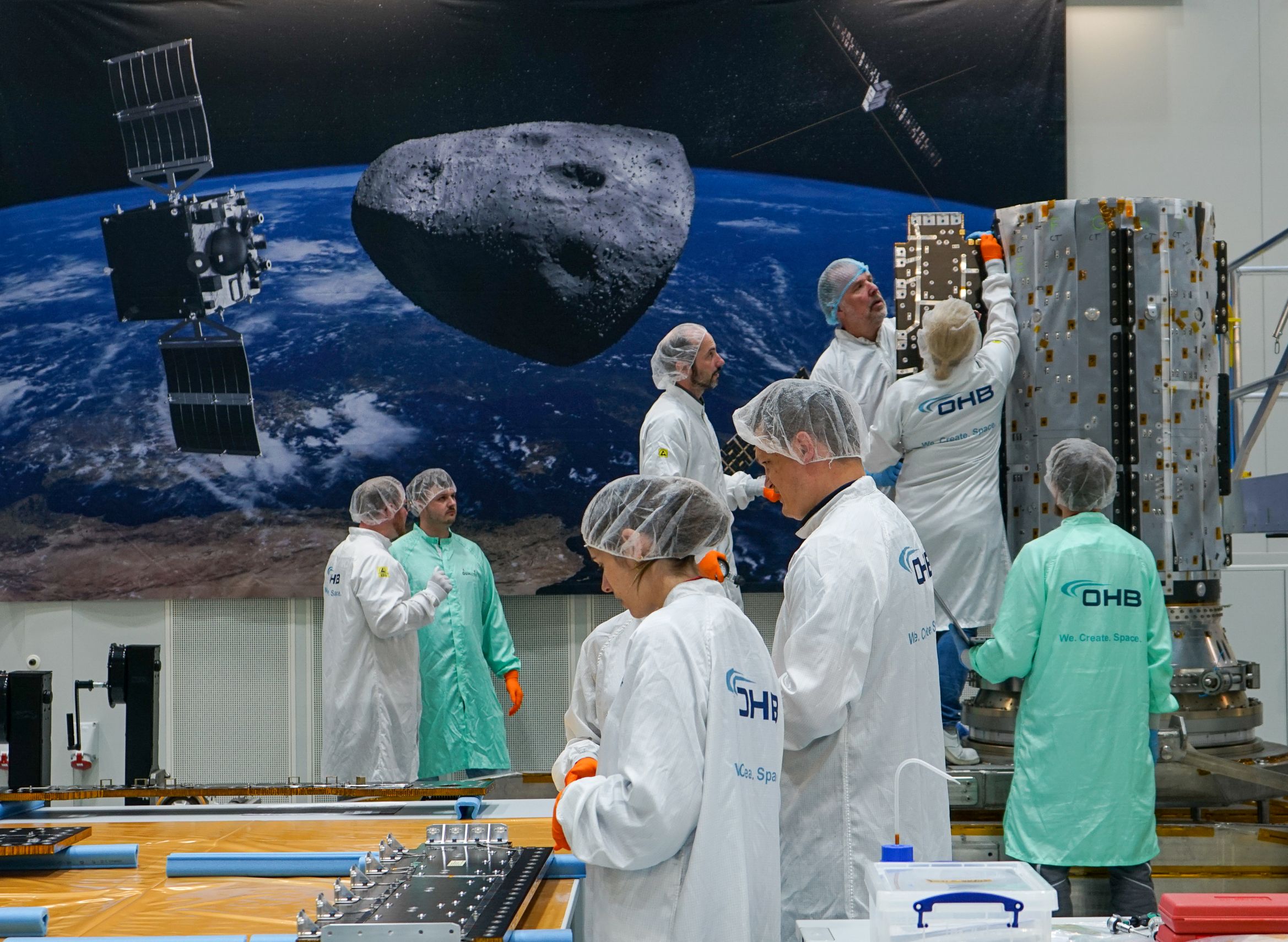
From now on, every week counts: Assembly of the European-led planetary defense mission RAMSES (Rapid Apophis Mission for Space Safety) has officially begun in the cleanroom at OHB in Bremen. With the spacecraft now taking shape, the project is gaining momentum under significant time pressure. To reach the asteroid Apophis ahead of its spectacular close flyby of Earth in April 2029, the RAMSES spacecraft must be launched as early as spring 2028.
“RAMSES represents Europe’s clear ambition to take a leading role in planetary defence – and our ability to successfully deliver highly complex missions even under extreme time pressure,” says Marco Fuchs, CEO of the space and technology group OHB. “It is impressive to see how this project is now taking shape in the cleanroom. Together with ESA and our international partners, we are building on our experience from Hera to bring this mission forward on schedule – and to set new scientific and technological standards.”
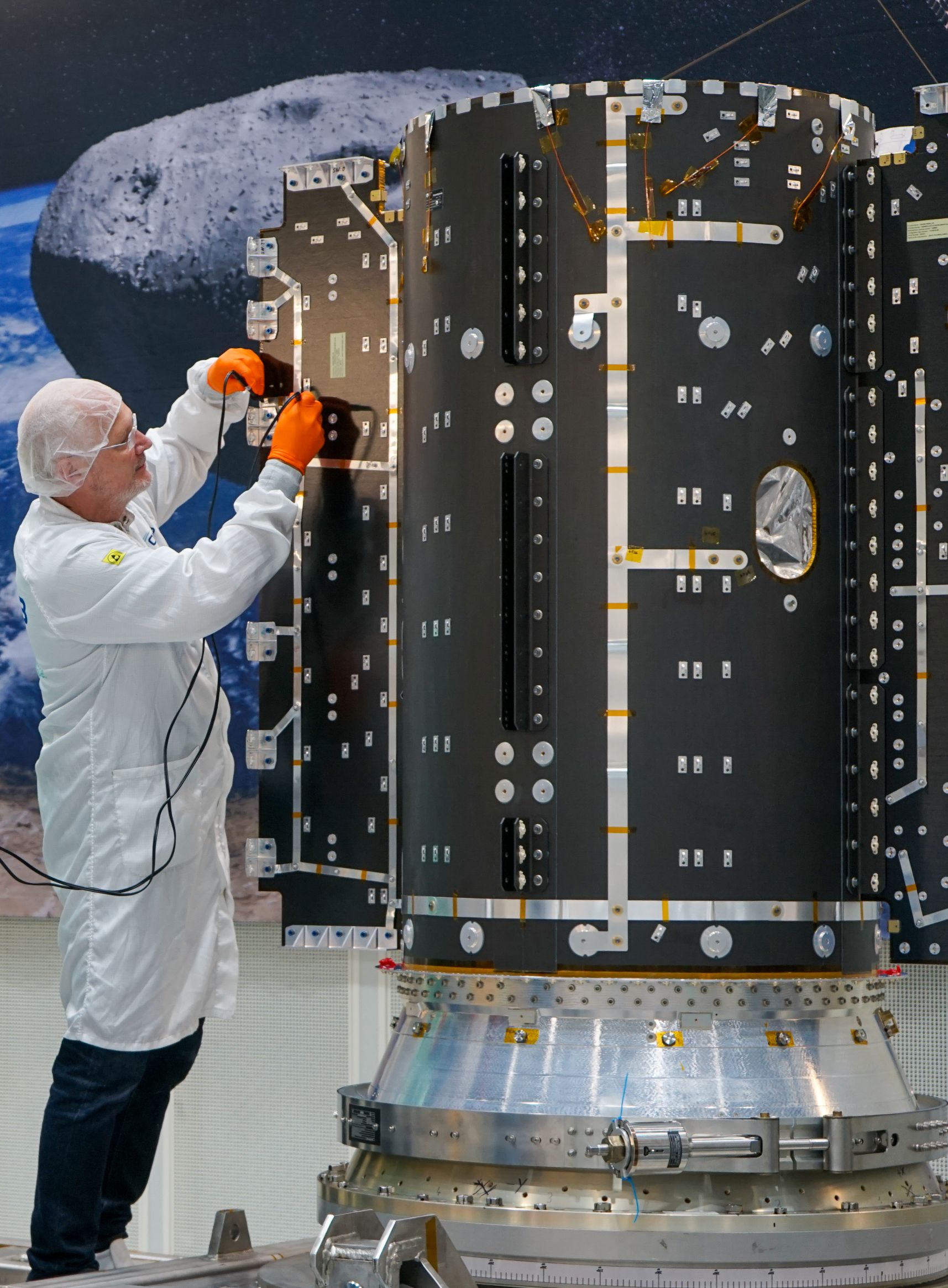
At the heart of the current integration activities is the spacecraft’s central tube. Measuring approximately 1.55 metres in height (1549 x 945 x 945 mm) and weighing just under 40 kilograms, it forms the structural backbone of the spacecraft. In Bremen, the first structural components are now being assembled, including panels and mechanical subsystems. The integration of these elements marks a key milestone in the development of the spacecraft’s two main modules.
From a technological perspective, RAMSES is based on ESA’s Hera mission, which was developed and built by OHB System AG in just four years. This Hera heritage enables the RAMSES mission to be implemented on a record timeline: development, integration and testing of the spacecraft must be completed within only 3.5 years to reach the asteroid in time. ESA has appointed OHB Italia as prime contractor for the spacecraft, with parts of the spacecraft being built at OHB in Bremen.
Tight schedule – European teamwork
OHB System AG is leading the structural integration, bringing together key components from international partners: the central tube supplied by Beyond Gravity, structural panels from APCO, and additional support structures from OHB Czechspace.
“With the start of integration activities in the cleanroom, RAMSES has clearly entered its implementation phase,” says Dr Andreas Gierse, responsible at OHB for the spacecraft’s structure, thermal and propulsion systems. “The schedule is ambitious, but thanks to our experience – particularly from the Hera mission – we have the know-how needed to meet this tight timeline while ensuring the highest quality standards.”
The spacecraft will consist of two main modules: the Propulsion Module, which will be shipped at the end of June to ArianeGroup in Lampoldshausen for integration of tanks, thrusters, valves and piping, and the Core Module, which will be developed in parallel at OHB Italia in Milan and will host the main electronics, including the on-board computer, attitude control system, and communication and navigation subsystems. Final integration of both modules into the complete spacecraft is planned for early 2027 at ESA’s ESTEC facility.
“Currently, around 35 specialists are working on RAMSES in Bremen across two teams: about 20 experts in structures, mechanics and propulsion, and around 15 in system engineering, avionics and software validation. The latter are using, among other things, a modified testbed from the Hera mission to develop and test the new mission software and scientific instruments. We are on track,” says RAMSES Project Manager and Hera Chief Engineer Diego Calzolaio.
A key mission for planetary defence
RAMSES is one of ESA’s flagship missions in the field of planetary defence. Its goal is to study the approximately 375-metre asteroid Apophis at close range, particularly during its extremely close flyby of Earth on 13 April 2029. During this event, the asteroid will pass at a distance of just around 32,000 kilometres – closer than many satellites – and will be visible to the naked eye.
The mission will focus on observing how Earth’s gravity affects the asteroid’s structure, which is believed to consist of loosely bound rock, dust and ice. Two CubeSats will provide detailed measurements: one will be deployed at low altitude and land on the surface, while a second will orbit the asteroid, observing its behaviour and analysing its composition.
The data gathered by RAMSES will help close key knowledge gaps about the physical properties of asteroids, contributing to the development of future strategies to protect Earth from potential impacts.